
Entertainment & Media · Pillar 04
THE HORIZON
DISTRICT
A master-planned sports, entertainment, media, and commercial district built on reclaimed fairground and supporting land — anchored by a 6,000-seat Arena, a 5,000-seat Ballpark, a Central Valley Media District, and year-round supporting commercial activation.
10-Plus Year Vision — If Pursued. The Horizon District is a generational, phased investment. The timeline begins when the decision is made to move forward — full build-out will take more than a decade. All cost figures are conceptual planning estimates intended to guide discussion, not final bids, appraisals, or approved project costs.
Funding Principle
The Horizon District is envisioned as a long-term public-private investment. The City's role is to create the conditions — infrastructure, land strategy, and financing frameworks — that attract private operators and developers. No single public funding source is assumed. Final financing structures require feasibility analysis, public review, and formal Council approval.
±90
Acres
Fairgrounds + TID Equipment Yard
6,000
Seats
Arena Capacity
5,000
Seats
Ballpark Capacity
70+
Games
Annual Home Baseball Games
The Opportunity
±90 ACRES.
ONE INTEGRATED
DISTRICT.
The Horizon District turns reclaimed fairground land into something Turlock has never had — a real sports and entertainment destination. The Arena, The Ballpark, a Media District, a cinema, and a full commercial district all in one place, built to draw visitors and generate revenue year-round.
This is more than games and concerts. It is a long-term economic engine — new jobs, new businesses, new tax revenue, and a reason for people across the Central Valley to choose Turlock.
The Arena and Ballpark share back-of-house operations — parking, kitchens, loading docks, utilities, and event systems — so the district runs efficiently and more revenue reaches residents.
Pillar
Entertainment & Media — Pillar 04
Site
Relocated Stanislaus County Fairgrounds & TID Equipment Yard
Acreage
±90 Acres — Fairgrounds + TID Equipment Yard
Anchor Venues
The Arena (6,000) + The Ballpark (5,000)
Additional Components
Media District · Retail · Dining · Hospitality · Mixed-Use
Infrastructure
Shared Parking · Kitchens · Loading · Transit Integration
Revenue Model
Expands Turlock's tax base and generates ongoing net revenues
Approach
Phased, long-term investment — public + private + P3
Concept Proposal
SITE PLAN — TURLOCK HORIZON DISTRICT
±90 Acres · Turlock, California · Conceptual Rendering
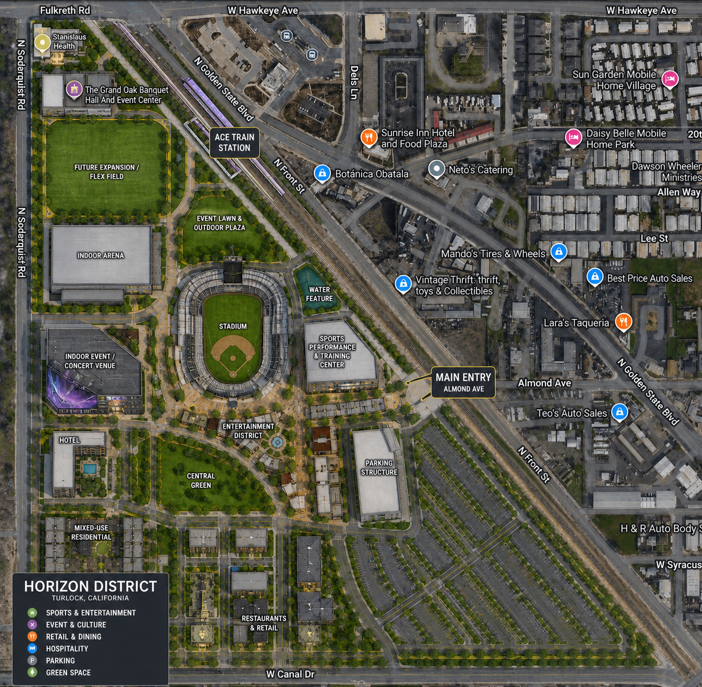
Conceptual site plan for illustrative purposes. Final design subject to community input, City Council approval, and environmental review.
District Components
WHAT THE DISTRICT INCLUDES
THE ARENA
6,000-Seat Multi-Purpose Venue
A flexible regional venue capable of hosting professional or developmental basketball, touring concerts and entertainment events, graduations, tournaments, conventions, and civic gatherings — as well as CSU Stanislaus athletics, TUSD championships, and regional events under joint-use agreements.
Key Elements
Professional or developmental basketball — bringing pro sports to the Central Valley
Touring concerts and major entertainment events
Graduations, tournaments, conventions, and civic gatherings
CSU Stanislaus athletics and TUSD championships under joint-use agreements
Shared back-of-house operations with The Ballpark for maximum efficiency
THE BALLPARK
5,000-Seat Professional Stadium
A professional-caliber venue capable of supporting Minor League or independent professional baseball, amateur and collegiate competitions, community events, tournaments, and seasonal programming — generating consistent year-round foot traffic and supporting local businesses.
Key Elements
Minor League or independent professional baseball — 70+ home games per season
Amateur and collegiate competitions
Community events, tournaments, and seasonal programming
Proven economic model for cities of Turlock's size and growth trajectory
Shared infrastructure with The Arena to maximize district revenues
MEDIA DISTRICT
Central Valley Broadcast & Production Hub
A dedicated media and broadcast hub — local and regional TV, sports coverage, news, and production jobs, all based in Turlock. This fills the gap between Sacramento and Fresno and gives the Central Valley a stronger media identity.
Key Elements
Support for local and regional broadcasting infrastructure
Central Valley platform for sports, news, and cultural programming
Production, communications, and media-sector job creation
Fills the broadcast gap between Sacramento and Fresno
Supports Tri-Agency education pipeline with media and communications pathways
PRIVATE-SECTOR CINEMA & PREMIUM THEATER
Entertainment Anchor · Daily & Evening Foot Traffic
Encourage the development of a privately operated cinema, IMAX-style premium theater, or comparable entertainment venue within the Horizon District. This facility would not be a city-owned theater, but a private commercial anchor designed to complement the arena, ballpark, media district, restaurants, and mixed-use activity.
Key Elements
Privately operated — no city ownership or operational liability
Creates daily and evening foot traffic on non-event days
Expands family entertainment options for Turlock and the Central Valley
Supports film premieres, community screenings, and cultural programming
Strengthens the district as a year-round regional destination
SUPPORTING COMMERCIAL DISTRICT
Retail · Dining · Hospitality · Mixed-Use
The Horizon District is built to be busy every day — not just on game nights. Restaurants, shops, a hotel, and mixed-use development keep the district active year-round and support the businesses and jobs that grow up around it.
Key Elements
Retail and dining activating the district on event and non-event days
Hotel and hospitality development serving regional visitors
Mixed-use development creating a live-work-play environment
Transit integration connecting the district to the broader Turlock network
Year-round activation strategy reducing dependence on event-day traffic alone
Shared Infrastructure Model
SHARED INFRASTRUCTURE. MAXIMUM RETURNS.
To reduce cost and maximize efficiency, The Arena and The Ballpark share parking structures, commercial kitchens, loading and service areas, operations and maintenance support, and event circulation and security systems — reducing overhead and maximizing net revenues for the city.
Economic Impact
THE ECONOMIC CASE
FOR THE HORIZON DISTRICT
The Horizon District is intended not only as an entertainment destination, but as a long-term economic catalyst for Turlock and the broader Central Valley. The figures below are conceptual estimates intended to illustrate potential economic scale — not serve as a final economic impact study. Actual results would depend on operator quality, event programming, tenancy, regional draw, media activity, and long-term district activation.
$350M–$800M+
ONE-TIME CONSTRUCTION ACTIVITY
The core district buildout may reasonably support an estimated $350 million to $800 million or more in one-time regional economic activity during planning, construction, and phased delivery — generating substantial employment and supply-chain spending across the Central Valley.
$20M–$60M+
ANNUAL RECURRING ECONOMIC ACTIVITY
Once operational, the core district may support approximately $20 million to $60 million annually in recurring economic activity through events, visitor spending, venue operations, and supporting commercial activity. As the surrounding district matures, the broader area could potentially support $40 million to $100 million or more annually.
Thousands
CONSTRUCTION & PERMANENT JOBS
The district will generate substantial construction employment during the build phase, and permanent jobs in hospitality, events, media production, operations, retail, and support services — creating a new employment base in Turlock's entertainment and media economy.
Year-Round
ENTERTAINMENT ECONOMY EXPANSION
The Horizon District is designed to expand Turlock's year-round entertainment economy — not just event-day traffic. Retail, dining, hospitality, and media production create economic activity on non-event days, reducing revenue volatility and building a more resilient district economy.
Regional
TOURISM & VISITOR DESTINATION
A professional sports venue, major concert arena, and media district positions Turlock as a regional destination — drawing visitors from across the Central Valley and beyond, supporting local businesses, and improving the City's ability to host major regional events.
Central Valley
MEDIA & BROADCAST PLATFORM
The Media District gives the Central Valley a stronger platform to tell its own story through sports, media, and regional cultural programming — creating a distinct media market between Sacramento and Fresno and reinforcing Turlock's role as the region's economic, educational, and entertainment capital.
Disclaimer
All economic activity figures are conceptual estimates only and are intended to illustrate potential scale, not serve as a final economic impact study. Actual results would depend on operator quality, event programming, tenancy, regional draw, media activity, surrounding private investment, and long-term district activation.
Conceptual Cost Overview
UNDERSTANDING
THE INVESTMENT SCALE
The Horizon District should be understood as a long-term, phased investment that may involve both public infrastructure and private, tenant-driven, or partnership-based development. All figures below are conceptual planning estimates only — intended to guide discussion, not represent final bids, appraisals, or approved project costs.
Public / Public-Supported
$80M – $180M
Core public district components
Land preparation, circulation, utilities, parking systems, public realm improvements, design, engineering, legal, and contingency — plus any public participation in venue delivery.
Relocation, land transition, demolition, and replacement-site support may add a separate conceptual range of $30M to $120M+.
Private / Operator / Mixed-Use
$140M – $320M+
Private and partnership-based development
Venue operator participation, supporting commercial uses, hospitality, media facilities, and surrounding mixed-use development — delivered over time through operator agreements, private development, and phased commercial activation.
This portion would not be a direct City-funded obligation.
Full District Vision
$250M – $620M+
Total long-term investment range
Including both public/public-supported components and surrounding private or partnership-based development, the full Horizon District concept may ultimately represent a long-term investment across all phases and participants.
A phased approach may significantly reduce upfront public cost by prioritizing infrastructure and site readiness first.
Important Notice
These figures are conceptual estimates only and are intended to illustrate potential scale, not serve as a final development budget. All funding paths described here are conceptual and would require future feasibility analysis, public review, legal evaluation, and formal approval before implementation.
Funding Strategy
POSSIBLE FUNDING
AVENUES
The final financing structure for the Horizon District should remain open for public discussion, formal analysis, and future Council consideration. No single funding source is assumed at this stage. A realistic long-term strategy may involve a combination of public financing tools, private investment, and operator participation.
PUBLIC FINANCING TOOLS
Possible public funding avenues that may be available depending on project structure, legal eligibility, and voter or Council approval.
Road, utility, parking, and circulation infrastructure funded through capital financing
General obligation bonds, subject to voter approval, for eligible public improvements
Revenue bonds or similar structures for public-supported components
Enhanced Infrastructure Financing District (EIFD) or similar tools to capture increased property value
State, federal, and regional grants for infrastructure, mobility, sustainability, and economic development
Parking and district-support revenue mechanisms
Phased capital budgeting that spreads the City's investment over time
PRIVATE INVESTMENT & PARTNERSHIP TOOLS
Private and partnership-based funding avenues that reduce the City's direct financial obligation while aligning private interests with district success.
Venue operator or team participation
Public-private development agreements
Ground leases and long-term land value capture
Private financing of supporting retail, hospitality, mixed-use, or media facilities
Naming rights, sponsorships, and event partnerships
Revenue-sharing structures tied to district performance
Phased Delivery as a Financing Strategy
Phased delivery is also a financing strategy. By advancing the district in stages, Turlock can align each component with available funding sources, operator commitments, market demand, and public priorities — reducing the need for a single large initial funding commitment. All funding paths described here are conceptual and would require future feasibility analysis, public review, legal evaluation, and formal approval before implementation.
Project Timeline
FROM PLANNING
TO ACTIVATION
Phase 1
Early Phase — If Pursued
PLANNING & SITE STRATEGY
Initiate Horizon District feasibility and site planning process
Commission land use, environmental, and infrastructure studies
Establish Horizon District Advisory Committee
Begin fairgrounds relocation coordination with Stanislaus County
Identify federal, state, and regional grant opportunities
Engage potential venue operators and P3 development partners
Phase 2
Design & Financing Phase
DESIGN & FINANCING
Complete site master plan and environmental review
Finalize land transition and fairgrounds relocation strategy
Structure EIFD or value-capture financing district
Secure operator commitments for Arena and Ballpark
Negotiate P3 agreements for commercial and media components
City Council approval of phased financing plan
Phase 3
Long-Term Build — Multi-Year Construction
INFRASTRUCTURE & VENUE CONSTRUCTION
Site preparation, demolition, and infrastructure delivery
Shared parking, utilities, and circulation systems
Arena and Ballpark construction
Media District facility construction
Phased opening of venues as construction completes
Phase 4
Activation — Years After Construction
COMMERCIAL ACTIVATION & GROWTH
Retail, dining, and hospitality district activation
Mixed-use and hotel development on surrounding parcels
Full media district programming launch
Long-term district management and expansion planning
"
The Turlock Horizon is designed to move our city forward — making Turlock more efficient, more prosperous, and more connected. The Horizon District gives the Central Valley a platform to tell its own story.
— Jeremy Rocha
Connected Initiatives
PART OF A LARGER VISION
HELP BUILD THE HORIZON DISTRICT
Support the campaign and help bring professional sports and entertainment to Turlock.